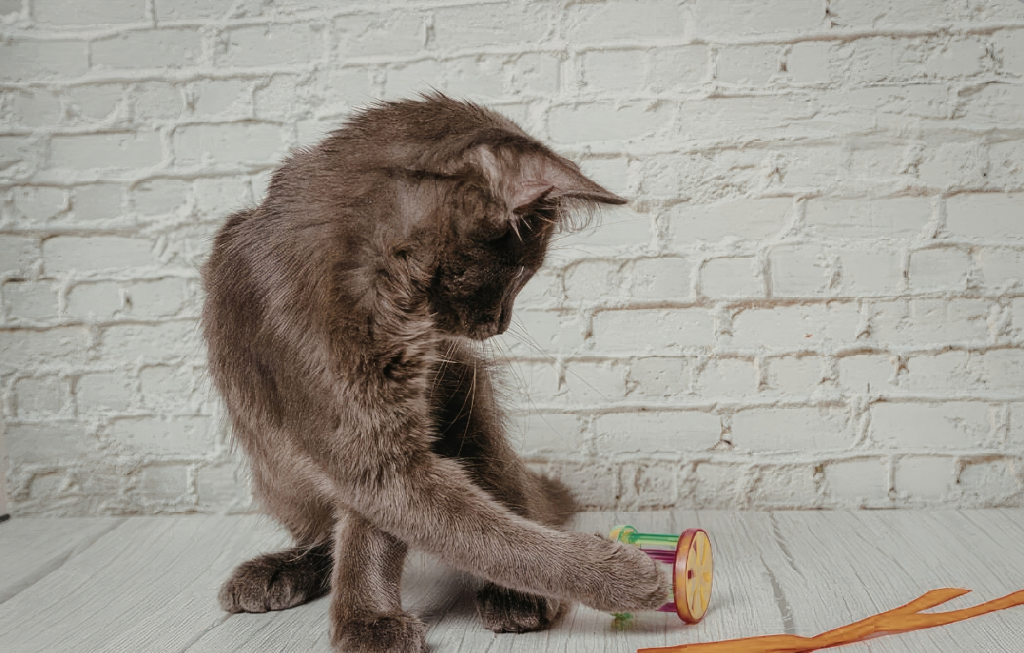
If you’ve ever wondered what your cat was doing before they leap across the room to attack their favorite toy mouse, you’re not alone. Watching your kitty creep across the room toward a silly little crinkle ball until you can’t stand it anymore and you toss it directly to them is easily one of my favorite parts of cat ownership.
I’ve spent years observing cats stalk toys both intentionally and accidentally (“Oh look, let me sit down to watch TV!”), and quickly learned that every wiggle, twitch, and stare carries meaning. Cats aren’t weird for weirdness’s sake. Sure, some of their behavior can seem random and silly. But most of it? Pure function. Bonus: knowing what your cat is doing can help you be a better play partner, too.
The Science Stuff: Why Cats Do These Things
OK, let’s get some background out of the way first. Your domestic kitty still possesses the entire predatory hunting toolkit their big-cat ancestors developed over millennia. Every single cat you’ve ever known has the brain structure of a hunter, even if Fluffy has never set paw outside your apartment.
That means every toy — whether it’s specially designed by humans (feather wands, laser dots, squeaky mice) or something you just tossed on the ground in frustration (a crumpled receipt, crinkled foil) — will trigger the same innate response.
This predatory sequence isn’t optional for your cat. It’s instinct. And because it’s instinct, most cats will complete the sequence in roughly the same order every single time. The behaviors we’re discussing below are not adorable flukes. They are steps in the story your cat acts out every time they decide to “hunt.”
Okay, now onto the best part:
Things Cats Do Before Attacking Toys
1.The Wild Lock-On / Unblinking Eye Contact
That death stare your cat gives humans doesn’t hold a candle to their toy-staring capabilities. You’ll notice your cat fixate on the toy prey and will not stop looking at it. The toy has become their entire world.
Your cat’s pupils will dilate, and you’ll notice their breathing probably slows in this phase, too. Everything else just ceases to exist.
Think of this as target acquisition. If a cat loses eye contact with prey too soon in the wild, they lose the prey. They also use that stare to track micro-movements, since most prey won’t just sit there and wait to be caught. Even the smallest wiggle will register. Honestly, if you’ve ever received this type of death stare from your cat while holding a feather toy, you know how effective it is. Sends shivers down your spine.
2.The Low Creep / Belly to the Ground
Next thing you know, they’re creeping closer with almost every inch of their body flat to the ground. Watching your cat do this always cracks me up because it really looks like they’re scheming up some master plan to annihilate that little bit of toilet paper.
Lowering to the ground is another behavior cats exhibit in the wild before pouncing on prey. By getting lower, cats: A) become a smaller visual target, and B) shift their weight forward, putting their body into a coiled position to spring forward faster and farther at the end of the creep. It’s literally like they’re loading up a spring every time they do this, and when they jump — boing.
3.The Tail Twitch
Watch your cat’s tail when they’re stalking. If you pay close enough attention, you’ll usually see their tail tip slowly twitching back and forth. Or the entire tail will begin flicking rapidly left and right as the moment of attack draws nearer.
While it looks like sheer willpower keeping that tail still during the creep, scientists think the tail twitch is actually your cat attempting to keep themselves calm and controlled. On one hand, they don’t want to scare off their “prey.” But because their bodies are literally wound up like springs, they need somewhere to release that tension. Enter: the excited tail wag.
4.The Butt Wiggle
Okay, you’re going to laugh every time you see this one. Right before your cat launches into attack mode, they’ll often shift their weight backward onto their haunches and perform a very deliberate wiggle with their butt.
As silly as it looks, there’s actual mechanical purpose to the butt wiggle. Your cat is double-checking the traction on the floor beneath their back feet so they know how much force to use when pouncing without slipping. It also allows them to adjust their aim and center of gravity one final time before jumping. Scientists have seen cats in the wild exhibit this exact behavior before attacking prey. If your house cat does this before attacking a toy, consider yourself lucky — you can watch a lion do its homework anytime you want on National Geographic.
5.The Chitter
Does your cat make a funny little chattering or clicking sound when watching toys? Not every cat does it, but many do, and it always startles me when I hear my cats do it for the first time.
The chitter (also called chattering) is a rapid-fire vocalization that sounds almost mechanical — sort of like a cross between a trill and biting into a crisp piece of celery. It usually means your cat is fixated on something they can see but can’t immediately reach.
Watch your cat near a window and you might hear it when they spot a bird they can’t swipe at. Indoors, you’ll probably hear it when that red dot is tantalizingly out of reach.
We don’t know for sure why cats do it, but researchers suspect the behavior may be driven by frustration, mimicry of prey, or tension release during periods of high arousal. However it started, the chitter means your cat is fully focused on that toy. And trust me when I say the attack will come any second now.
6.The Freeze
Have you ever noticed that many cats will go completely stiff right before they leap?
We’re not talking quiet, either — many cats will freeze entirely. Stare? Check. No tail movement? Check. Stiff muscles? Absolutely.
During the freeze, your cat stops moving to take one last look at the target. In that moment, they’re calculating distance, timing, trajectory, and predicting how their prey will move when they leap. It can last anywhere from a second to just about as long as you’re willing to wait before tossing the toy.
The freeze is one of those strange things cats do before attacking toys that owners frequently miss. After all, it looks like nothing is happening. But trust me — plenty is going on inside that little head.
7.The Pre-Pounce Chirp / Meow
Finally, one more sound your cat may make before pouncing. This one is far less universal than the chitter, but it’s still pretty adorable when it happens. Right before launching, some cats will emit a short chirp, meow, or trill.
Some researchers believe cats who live with other cats may do this as a leftover group communication behavior. The majority of cats who hunt alone don’t do this, which supports that theory. Others believe your cat simply can’t contain their excitement right before jumping.
Why It Matters
Let me bring this back around to you for a second.
Understanding why your cat does these things can help you become a better play partner and give your cat the best possible play session. When you notice them starting to stalk, hold off on tossing the toy — let them get into position. When you see that butt wiggle loading up, keep the toy momentarily still so your cat can adjust their final leap. When you see the freeze, don’t interrupt. Let them commit to that jump.
Cats that complete the entire predatory sequence during play are happier and more satisfied afterward. They tend to relax more easily, groom themselves more contentedly, and act less frustrated or hyperactive after play sessions that allow them to “hunt” fully.
Conclusion
Sure, it’s fun to make silly faces at your cat when they’re doing the butt wiggle. Believe me, I will never stop doing that to my cats. But those cute and quirky behaviors are part of an ancient predatory process that helps fulfill your cat’s needs. From eye contact to tail twitch, it’s incredible that a glorified spool of toilet paper can turn your cat into a tiny tiger.
Next time you catch your cat doing their ninja warrior routine before destroying that tiny bit of cardboard dancing across the floor, take a moment to appreciate the show. You’re not just watching a silly cat. You’re watching millions of years of predator wrapped up in a cheap fur coat. And your job is simply to make sure that fur-coated predator feels well stimulated when the deed is done.

- 7 Strange Things Cats Do Before Attacking Toys - March 9, 2026
- 6 Signs Your Dog Is Secretly Protecting You - March 9, 2026
- 5 Reasons Dogs Follow You To The Bathroom - March 9, 2026