You’re here because you’ve Googled how to motivate stubborn dogs without force. Odds are you’re feeling frustrated, defeated, or maybe even a little worried.
You know you’re doing everything “right.” You love your dog, you’ve followed all the advice… so why do they still ignore cues, refuse to listen, or dig their heels in every time you ask them to do something?
First, take a deep breath. I promise you and your pup can turn this around.Stubborn dogs aren’t bad, defiant, or doomed to a life of failed cues. They simply need to be motivated differently.
Why Some Dogs Are “Stubborn”
Dogs aren’t stubborn. They just seem that way because of how we interpret their behavior.
What we label as stubbornness is almost always driven by one or more of the following:
-
Your dog doesn’t see value in what you’re asking
-
Your dog is unsure of what you want
-
Your dog is overwhelmed, stressed, or distracted
-
Your dog has learned there are no consequences for ignoring cues
-
Your dog’s needs aren’t being met
Plain and simple: if your dog is being “stubborn,” there’s a reason.
It’s your job as their caregiver to uncover the root cause. Don’t assume your dog is willfully disobeying you. They’re trying to tell you something—and until you listen, cues will continue to be ignored.
Why Forceful Training Methods Usually Fail
When I say force, I don’t just mean hitting or physically punishing your dog. Yelling, leash pops, intimidation, dominant posturing, and rigid training practices are also forms of force.
Why do trainers use force? Because it works… sort of.
Pressure might solve your problem in the short term, but creating meaningful, long-term change requires trust, relationship-building, and cooperation from your dog. Using force accomplishes none of those things.
Think about it this way:
If you told me to do something I disliked or didn’t understand, I could do it. But would I be excited to do it again? Probably not. And if I were forced to do something repeatedly, I’d look for ways to avoid it.
The same goes for dogs.
When you push your dog into listening rather than motivating them, you’re setting yourselves up for failure.
With that being said…
How Do You Motivate a Stubborn Dog?
Remember earlier when I mentioned motivation-based training? That’s the key to creating lasting change with your dog.
Motivation is the driving force behind all behavior.
When dogs are motivated, they’ll choose to do something without you having to demand it. When they’re not, no amount of yelling or leash-jerking will magically make training better.
Instead of asking how to motivate your dog during training, start with this question:
Why should my dog listen to me?
If you can’t answer that in a way that excites your dog, they won’t listen.
You need to make the behavior you’re asking for worth their time and effort.
Here’s how to do it.
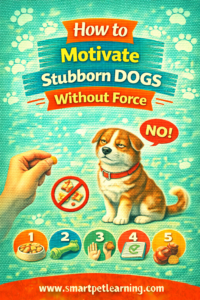
9 Steps to Motivating Stubborn Dogs
Step 1: Find Out What Motivates Your Dog
Your dog is not your dogmate. Just because your significant other loves French fries doesn’t mean your dog will.
Think about the incentives you’ve tried in the past. Did your dog react with excitement, mild interest, or total indifference?
Most dogs are motivated by food, play, access, affection, or activity. If your dog isn’t food-motivated, they may be motivated by one of the others.
Test different rewards in a low-distraction environment. You’ll know you’ve found the right one when your dog lights up for it.
Step 2: Don’t Repeat Commands
Stop accidentally teaching your dog to ignore you.
There’s nothing more confusing for a dog than hearing the same cue repeated over and over:
“Sit. Sit! SIT! Are you ever going to sit?!”
Repetition teaches dogs that cues are optional. Once they learn that, listening becomes negotiable.
Instead, say the cue once. If your dog doesn’t respond, reset the situation and try again.
Step 3: Make Things Easy at First
Are you asking your dog to perform complicated behaviors in distracting environments before they’re ready?
Many dogs are labeled stubborn because they’re being asked to do too much, too soon.
Simplify behaviors and reward generously. Once your dog succeeds in calm environments, gradually increase difficulty.
Think of it like learning to walk before you run.

Step 4: Create Life Rewards
Dogs love being with you. That’s their whole jam.
Life rewards are everyday things your dog already wants. When you use them intentionally, you motivate behavior naturally.
-
Sitting calmly = leash gets clipped
-
Looking at you = door opens
-
Relaxing on the couch = you throw the ball
Helping your dog understand how good behavior directly improves their life is incredibly motivating.
Step 5: Rule Out Emotional and Physical Issues
Does your dog avoid training? They may be stressed or under-stimulated.
Are they itchy, restless, or uncomfortable? Health issues like allergies can affect focus.
Before assuming stubbornness, consider exercise, mental enrichment, chronic stress, and physical health.
Unmet needs sabotage motivation.
Step 6: Build Engagement First
Training should start when your dog is already engaged with you.
Many people jump straight into commands without building connection.
Reward your dog for choosing to be near you. Play together. Go on walks. Build value in your presence before asking for obedience.
Engagement fuels motivation.
Step 7: Be Consistent
Ask yourself:
-
Are rules always the same?
-
Are rewards predictable?
-
Are expectations clear?
Mixed signals create confusion, and confusion looks like stubbornness.
Create clear, consistent rules—and stick to them.

Step 8: Don’t Take It Personally
Your dog isn’t ignoring you to be disrespectful, dominant, or spiteful.
Unless trauma is involved, dogs don’t disobey out of malice.
When you stop taking behavior personally, you become calmer, clearer, and more effective as a trainer.
Step 9: Train the Dog in Front of You
Don’t train an idealized version of a dog. Train the one you have.
Does your dog learn slowly? That’s okay.
Are distractions hard? Lower the difficulty and build up gradually.
Stop comparing your dog to others. When training matches your dog’s pace, motivation increases.
Can’t Motivate Your Dog? Focus on Patience Instead
Patience isn’t passive—it’s intentional.
Throwing commands around until something sticks isn’t patience. It’s frustration.
Slow down. Observe your dog. Adjust your approach.
Patience makes you a better trainer and helps your dog feel safe enough to try.
Don’t Give Up
Motivating stubborn dogs takes time, practice, and consistency.
If you’ve tried these steps and are still struggling, hang in there.
You’re not failing—and neither is your dog.
You’ve got this.
Final Thoughts
Motivating your dog shouldn’t feel like a power struggle.
Our dogs rely on us to guide them, protect them, and teach them how to succeed in our world. When training isn’t working, it’s our responsibility to adapt.
Training is not one-size-fits-all. With time, patience, and the right approach, progress will come.
Don’t give up on your pup. They’re worth it—and so are you.
Save pin for later

- The Cutest Cat Breeds in the World - March 21, 2026
- Black Cat Names That Are as Mysterious and Beautiful as They Are - March 21, 2026
- Did You Know Your Dog Could Have Diabetes? - March 20, 2026