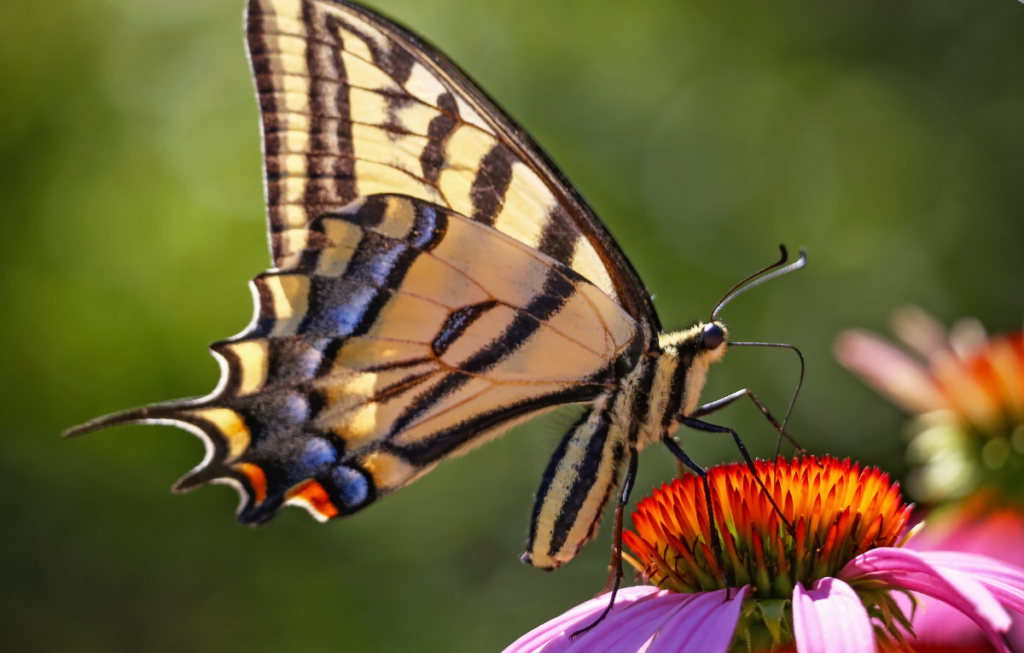
I cannot stress enough how cool butterflies are. Before doing the research for this article, I had always casually observed them; butterflies drifting by, languidly passing a sunny spot. Never did I once think about their anatomy, their biology — only admiring those beautiful wings in flight.
That was until I googled “interesting butterfly facts.” Amongst all of the fun tidbits, I learned that butterflies taste with their feet. I laughed when I first read it. Reading that sentence again for sure confirmed it wasn’t a joke.
I had to fact-check it twice. There is no way creatures with wings and brains that small can taste with their feet. Nature is wild. And butterfly chemistry is real.

Why Butterflies Are Pretty Incredible
Butterflies are like flowers. When you think of them, you think color, grace, and transformation. They symbolize change and hope. They are beautiful.
There is so much going on under the surface with these tiny creatures. Many will tell you that butterflies are insects with specialized wings. They are built to survive. Even in their beauty, butterflies are evolutionary masterpieces.
They belong to the scientific order Lepidoptera. This order encompasses all butterflies and moths. Millions of years of evolution have gifted butterflies with some incredible biological tools just to stay alive. Not only do they have wings covered in microscopic scales that reflect light to create patterns we admire — they can also see ultraviolet light that we cannot detect. And yes — butterflies can taste with their feet.
Butterfly feet are high-tech science that helps them survive and reproduce. I love learning about how and why. Especially when it is this cool.
How Butterflies Taste With Their Feet
Chemoreceptors are the scientific name for taste receptors. On butterflies, these receptors are located on their feet. Not only do butterflies have chemoreceptors on their feet — they are also insanely sensitive receptors.
By landing on various surfaces, butterflies can detect chemical signals given off by the things they land on. Each time a butterfly lands on a flower, a leaf, a piece of fruit, or the ground, they are instantly tasting what is beneath them.
No smelling with their antennae. No licking. Butterflies do not need to guess what they might be eating — their feet simply taste it.
Chemoreceptors allow butterflies to detect sugars, salts, water, and certain plant compounds. This helps them decide where to gather food, lay eggs, or just keep fluttering along. Their feet act like a scanner, allowing butterflies to investigate everything they come into contact with.

1. They Use Their Feet To Find Food
One thing butterflies are always looking for is food. They like food too! But in order to find food, they need to determine what is actually food and what is not.
Butterflies can land on a flower and then extend their long, straw-like tongues to eat nectar. In order to determine if a flower has nectar, they use their feet. Chemical receptors in their feet detect sugars and signal the butterfly that this is a flower worth feeding from.
If those receptors do not sense sugars, they may just as quickly take off and fly to the next flower. Food spots have to be high-quality and ready to go. They do not have time to land everywhere.
Constantly tasting with their feet allows butterflies to efficiently find food sources. Because butterflies do not live for very long, efficiency is key to their survival.

2. It Helps Them Decide Where to Lay Eggs
Choosing where to lay eggs is a crucial task for female butterflies. Butterfly larvae, also known as caterpillars, can be picky eaters. They will often only eat certain types of plants.
When a female needs to lay her eggs, she has to find the right kind of plant to leave her young on. The wrong plant could mean her caterpillars will have nothing to eat when they hatch. So she uses her feet.
Just like when hunting for food, a butterfly will land on a leaf and immediately use her feet to taste it. Every plant species has its own unique chemical makeup. By recognizing the subtle differences in these chemicals, a butterfly can identify exactly what plant species she has landed on.
This helps female butterflies guarantee that her eggs will have food when they hatch. Incredible.
3. Did You Know Butterflies Taste With Their Feet To Find More Than Food?
Butterflies taste with their feet to find more than food. They also use their feet to locate minerals and salts. Butterflies often indulge in what is called “mud-puddling.”
This behavior describes groups of butterflies congregating on wet soil, muddy puddles, animal droppings, or dead carcasses to absorb sodium and other minerals. Their feet help them find these nutrient sources.
By landing on soil or other mineral sources, butterflies can taste the presence of sodium through their feet. Without even bothering to deploy their proboscises, butterflies can search for and locate the minerals they need to survive.
Fun fact: Butterflies have also been known to taste human skin. When they land on you, they might be detecting salt. Gross? Maybe. But kind of amazing if you ask me.
4. Butterflies Taste Way More Accurately Than We Do
Butterfly chemoreceptors are so sensitive, they can taste certain things that we cannot. Scientists have discovered that butterflies can taste concentrations of sugar well below what humans would consider sweet.
We would perceive certain solutions as completely flavorless, but butterflies can pick up something delicious. Their feet act like miniature taste detectors, allowing them to search for food quickly and accurately.
5. They Are Not Alone
Other insects taste with their feet too! Flies have chemoreceptors on their feet. This is why you should worry if a fly lands on your food — it is instantly tasting its new food source.
Honeybees use their legs and antennae to taste as well. Like butterflies, many insects have developed the ability to taste with their feet. Different insects may use this skill for different purposes, but the basic function remains the same.

Butterflies Tasting With Their Feet: FAQ
Do all butterfly species taste with their feet? Yes, all butterfly species taste with their feet. Every butterfly in the world has chemoreceptors on their feet.
Can butterflies taste the same things we can? Sort of. Butterflies can detect sugar and salt just like we can. However, they can also detect plant compounds that we cannot begin to perceive.
Do butterflies have tongues? Butterflies do not have tongues, but they do have a proboscis. This is a long, tube-like structure they extend from their mouths to drink nectar. They will typically taste with their feet before even deploying it.
How sensitive are butterfly taste receptors? Butterflies can taste certain things at concentrations far below what we can detect. They have ultra-sensitive chemoreceptors that allow them to identify specific chemicals even in very low amounts.
Do butterflies benefit from tasting humans? If a butterfly lands on you and starts “tasting” you, it is most likely detecting salt on your skin. Butterflies need minerals and sodium to survive, and we provide it simply by sweating. It is not harmful to the butterfly or to you — but it is pretty cool.
Final Thoughts
Nature is so clever. Sometimes when I watch butterflies float around gardens and fields, I forget just how complex they are. They are more than just wings and flight. Their feet act as chemical analyzers, helping them thrive in a world we cannot fully perceive.
The next time you see a butterfly land on something, remember that they are experiencing life through their feet. We only see colors and patterns — butterflies are tasting everything we cannot.
Save pin for later


- How to Make a DIY Dog Bed That Is Cozy and Stylish - March 18, 2026
- How to Keep Ocean Fish Healthy in a Home Aquarium - March 18, 2026
- Did You Know Did You Know Butterflies Taste With Their Feet? - March 18, 2026